
Why the 5% of AI Pilots Succeed?
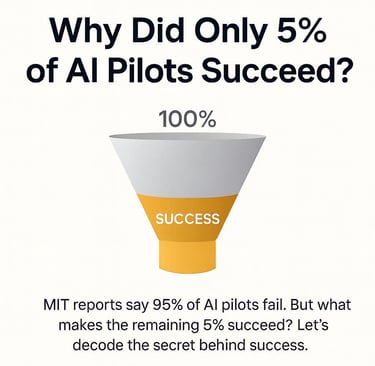
Blog post descWhile everyone fixates on the 95% failure rate in AI pilots (MIT report), the real lesson lies in understanding why the successful 5% deliver transformational results. As an AI consultant, I’ve distilled the winning formula into four key pillarsription.
10/6/20252 min read

1. Know Your AI Maturity: Crawl, Walk, or Run?
Every organization must assess its AI readiness through the lens of data maturity:
generated_image:556
Data Crawling: Collecting raw data across silos
Data Walking: Cleaning, integrating, and governing high-quality datasets
Data Running: Real-time data pipelines fueling AI-driven insights
Action:
Rate your data quality (accuracy, completeness, timeliness)
Identify the ideal pilot in one of these zones:
Data-Rich Segment (e.g., customer analytics)
Technology Strength (existing AI/ML expertise)
Industry Focus (domain-specific opportunities)
Heavy-Intensity Tasks (e.g., fraud detection)
Cost-Base Functions (HR, Sales, Engineering)
Punch line:
“Start your AI journey at the intersection of data maturity and business value—don’t run before you can walk.”
2. Measurable ROI: Define “Time to Value” Up Front
AI benefits—efficiency, productivity, innovation—are real but must be quantifiable.
Time to Implement + Time to Measure = Time to Value
Establish clear ROI metrics: cost savings, revenue uplift, productivity gains
Pro Tip:
“If you can’t articulate the ROI in weeks, you risk becoming part of the 95% failure statistic.”
3. Choose the Right Adoption Model
Your AI technology choice depends on organizational context:
generated_image:557
SaaS Solutions: Quick to deploy; ideal for data-crawling organizations
APIs / Developer Platforms: Balance speed and customization for walking-stage firms
Custom LLM/SLM: Deep integration and competitive moat for AI-running enterprises
Decision factors:
Company size and budget
In-house technical expertise
Data maturity and governance
Speed vs. control trade-offs
Punch line:
“Pick the AI adoption model that matches your runway and your vision—speed without a safety net leads to turbulence.”
4. Ownership, Trust & Human in the Loop
AI know-how is limited; trust is fragile.
Defined Responsibility: Own the AI solution end-to-end. Liability builds trust.
Legal & Ethical Frameworks: Codify AI governance, bias mitigation, and privacy compliance.
Transparency: Clearly communicate AI capabilities and limitations.
Human in the Loop: Guard against hallucinations and biases with human oversight at critical junctures.
Punch line:
“You’re not just deploying models—you’re building trust. Accountability is the foundation of sustainable AI.”
The 5% Blueprint for AI Success
Assess Your AI Maturity: Data crawling, walking, or running?
Define Clear ROI: Know your time-to-value before you pilot.
Select the Right Model: SaaS, API, or custom LLM—align with your strengths.
Embed Accountability: Responsible AI, legal/ethical guardrails, and human oversight.
Closing Remarks:
“Transformational AI isn’t a silver bullet—it’s a strategic journey. Master these four pillars, and you’ll join the elite 5% that turn AI ambition into business reality.”